
PESTLE RETRO 2026 - Economics of Consumer Spending
One Year Later: Is Your Product and Want or a Need and do your Customers Trust you?
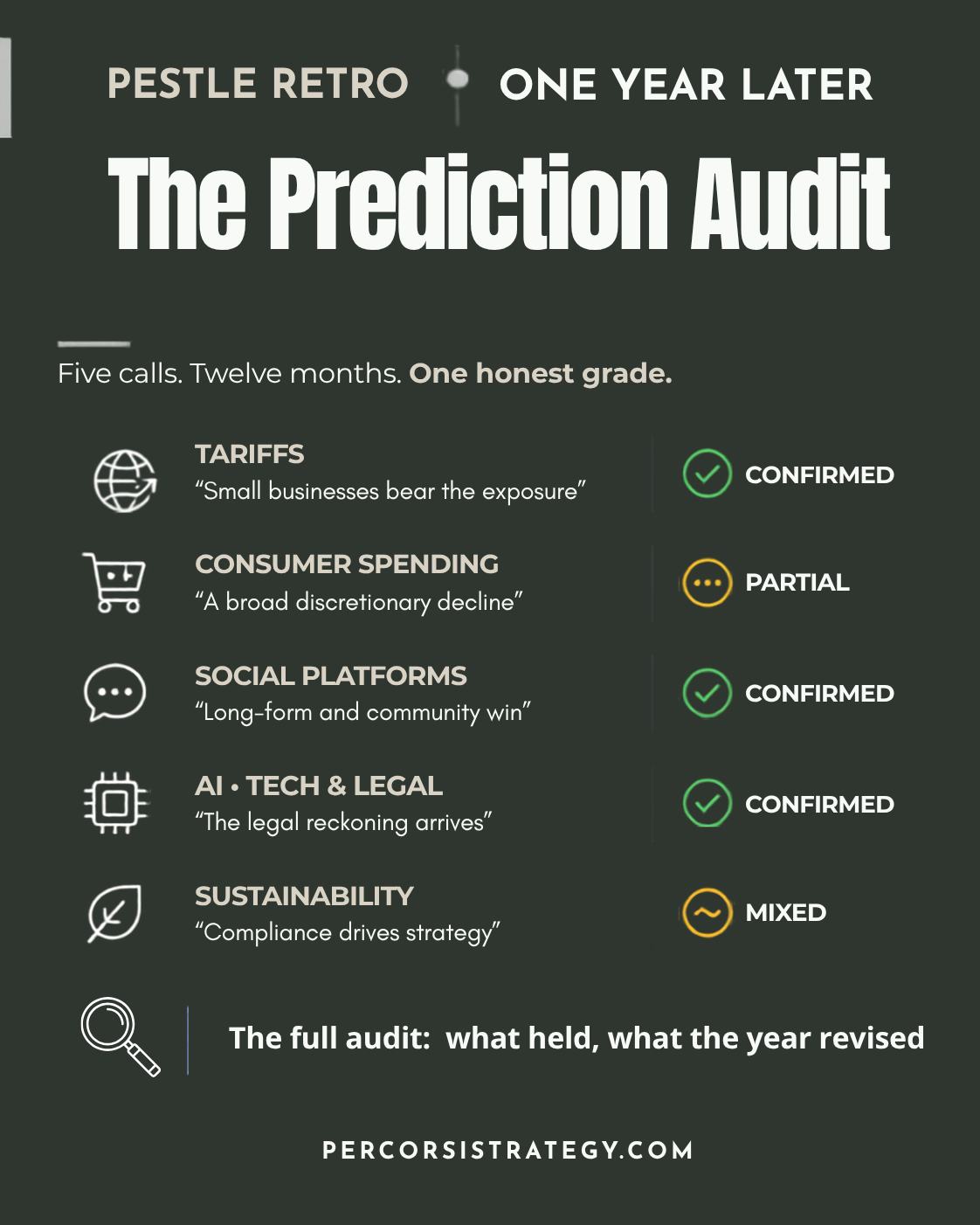
Anytime is a great time to check-in on the major decisions you make to stay in business. Beyond looking at your sales numbers, it helps to step back and look at the bigger picture outside your business too. That's where PESTLE Retro comes in. PESTLE stands for six outside forces that shape your business: Political, Economic, Social, Technological, Legal, and Environmental. For each one, ask three simple questions: What helped my business? What hurt it? And what should I change going forward? This isn't about predicting the future perfectly. It's about pausing long enough to notice what's actually happening around your business, so your next moves are based on real patterns instead of guesswork.
Key Takeaways:
Consumer spending has not slowed but is becoming more selective.
Value now means price plus proof.
Trust is the new competitive advantage and local businesses are gaining ground.
For Businesses: Essentials have to win the product vs. product comparison. Discretionary offerings must justify the purchase itself. Local businesses have an edge on the origin test.
Whether your product or service is a need vs. want, can it win based on price, quality, trust and origin?
The question for every business: whether you sell a need or a want, can you win on price, quality, trust, and origin?
People spend from two buckets: needs, like housing and groceries, and wants, like travel and entertainment. When budgets tighten, needs get funded first. Last year's article tracked early signs of stress in consumer spending. Those signs included shoppers paying for groceries with buy now, pay later plans like Affirm, and declining store traffic. The article also offered ways to better position your product or service. This 2026 update adds two variables to the consumer spending equation: value and trust.
2025 Prediction:
Consumer financial stress signaled a broader spending pullback
Discretionary spending would decline as budgets tightened
Spending follow the business cycle: downtown means cuts
Repositioning and segment-hunting would be the winning defensive plays
How did they hold up? Partly. Consumers didn't stop spending. They got selective.
Broader pullback: partly held. The stress was real, but spending shifted rather than stopped.
Discretionary decline: held. Consumers report plans to pull back across a broad range of discretionary purchases.
Business cycle: missed. Instead of simply cutting, consumers trade down and audit each purchase.
Repositioning: held, with an update. It's still the winning play, but value now includes quality, trust, and origin, not just price.
2026 Update:
While rising prices remain the top concern, value drives spending. More than three quarters of consumers still engage in some trade-down behavior (McKinsey ConsumerWise, The State of the US Consumer Q2 2026) while “Consumers reported plans to pull back across a broad range of discretionary purchases’ (McKinsey An Update on US Consumer Sentiment, August 2026). Companies across consumer staples and consumer discretionary segments are discussing ‘affordability’ with striking frequency; mentions among executives have tripled over the past five years through Q1 2026. Households are watching every dollar, and companies have noticed (Robeco).
Quality and Trust are part of the value equation. Consumers are redefining value to include what’s in the product and using scanning apps like Yuka and Scout to make that visible. Consumers are also paying attention to origin where applicable.
Consumer spending decisions are a function of Need vs. Want + Audit. Consumers still buy but with an eye towards optimization, switching from name brands to store brands, adjusting sizes, and seeking sales. Discretionary purchases are audited on whether to buy new, buy used or defer.
What This Means for Your Business
Consumers haven't stopped spending. They've started auditing. Your job is to pass the audit.
If you sell a need, you're in a head-to-head comparison. Win it with price plus proof. Show what's in your product, why it lasts, and why it's worth choosing over the store brand.
If you sell a want, your real competitor is "not now." Justify the purchase itself: what it solves, what it delivers, and why it's worth buying today instead of used or later.
If you're local, lead with origin. Make where you come from and who you serve impossible to miss.
Then run your offer through four questions:
Price: Is your price defensible against the cheaper alternative?
Quality: Can a customer see what's inside, or are you asking them to take your word for it?
Trust: What proof do you show before the sale, like reviews, transparency, and guarantees?
Origin: If origin matters in your category, are you telling that story?